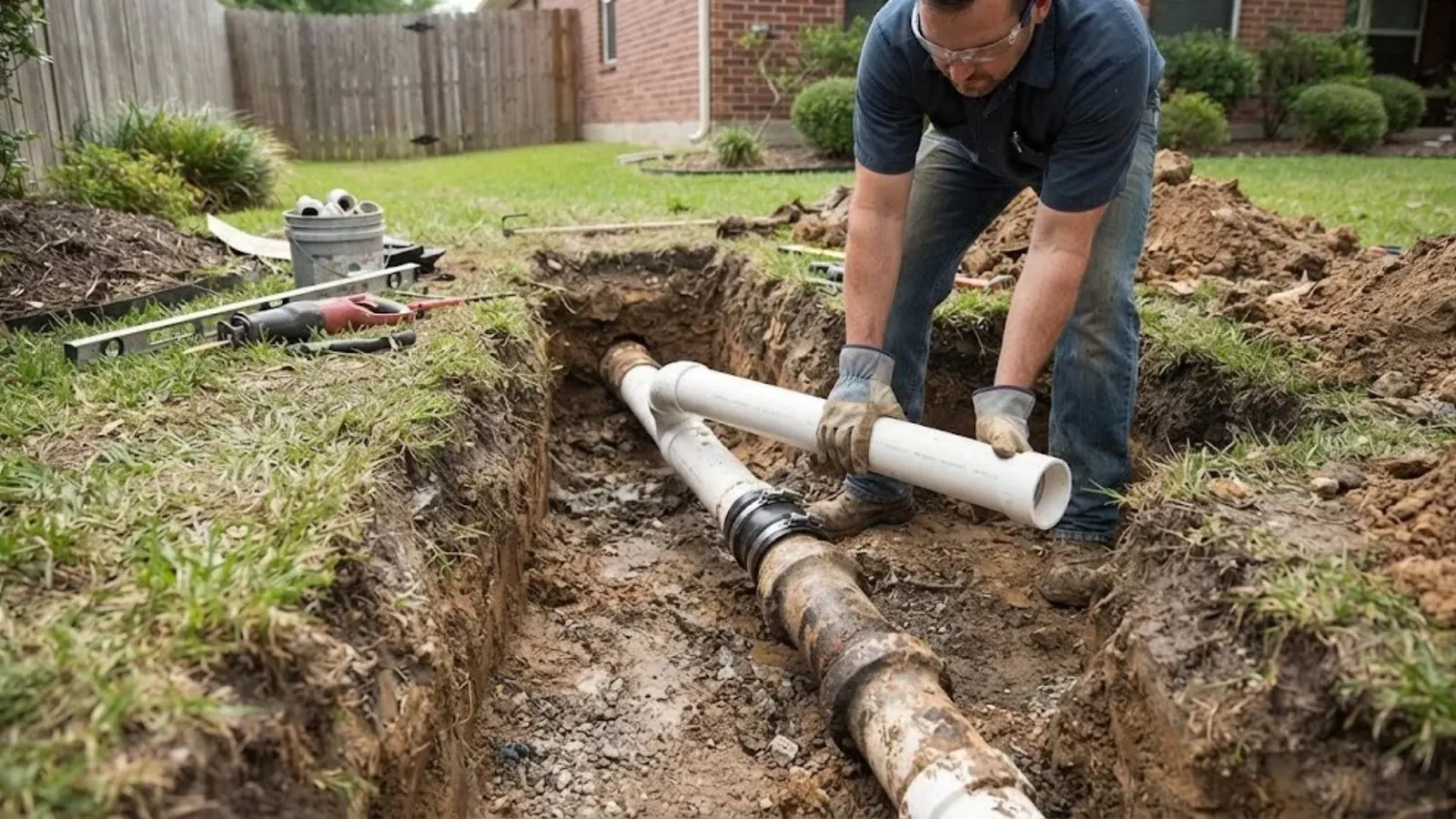
When cleaning is no longer the answer
A cable or a jetting pass treats a blockage. Repair treats the reason it keeps forming. If the same line backs up every few months, or a plumber reports that the cable hit a hard stop at a fixed distance, the pipe likely has a break, a sag or a joint that roots have opened.
Callers often describe a localized crack with roots and ask for a spot repair rather than a full dig. That is a reasonable question. Many damaged laterals have one or two bad sections, and the camera shows whether a short repair will hold or whether the rest of the pipe is too far gone.
Repair options, from least to most invasive
Which option fits depends on what the camera shows and how much of the line is damaged.
- Spot repairThe bad section is exposed, cut out and replaced. It suits a single break or offset with sound pipe on both sides.
- Pipe liningA resin-soaked liner is pulled through the old pipe and cured to form a new inner wall. It avoids a long trench but needs a clean pipe and a roughly round shape.
- Pipe bursting or full replacementThe old line is replaced end to end. It makes sense when the pipe is collapsed, heavily bellied or made of a failing material.
- Cleanout installationAdding an access point makes future cleaning and camera work simpler. It is often paired with any repair.
Cast iron, clay and plastic: what each one tells us
Older laterals are commonly cast iron or clay. Cast iron rusts from the inside and can flake until the opening narrows. Clay joints let roots in. Plastic pipes, such as PVC or ABS, hold up well but can sag if the trench was not backfilled evenly.
The camera report names the material and the defect. That decides whether lining is possible. A cast iron pipe with heavy scale needs cleaning before any liner goes in, which is where hydro jetting fits into the repair plan.
Who may do the work, and who must be called first
In Connecticut the state Department of Consumer Protection licenses plumbing work. Its P-1 license covers all plumbing and piping work for a contractor. A P-7 limited sewer, storm and water contractor license covers water, sewer and storm piping from the utility point to just inside a structure. You can check either one on the state eLicense lookup at elicense.ct.gov before you sign anything.
The sewer main is MDC's. The lateral that leaves your house is yours, and MDC states it will not assume liability if work starts before MDC is told. Call the MDC Command Center at (860) 278-7850 and press 1, then book the repair. If the digging touches the street or the main connection, MDC will tell you what its rules require.
Replacement and repair of a building sewer falls under the International Plumbing Code (IPC), adopted in its 2021 edition by the 2022 Connecticut State Building Code. Ask the permit office whether your repair needs a permit and an inspection.
Camera showed a broken line?
Call to book the repair plan. We explain the options and the price before any digging starts.
Repair choice at a glance
| Method | Digging | Best when |
|---|---|---|
| Spot repair | Small excavation at the break | One damaged section, sound pipe elsewhere. |
| Lining | Minimal, at access points | Roots or cracks in a round, continuous pipe. |
| Full replacement | Trench or burst path along the line | Collapse, heavy belly or failed material. |
What affects the cost of sewer line repair
Quotes follow the camera findings, not a guess.
Standard homeowner policies generally cover damage from a sudden event but not the wear on an aging pipe. Ask your insurer in writing before you assume anything is covered.
Common questions
Yes. Dispatch is open around the clock. After-hours visits focus on stopping the backup and diagnosing the line, and the repair is scheduled once you have approved a price.
Sometimes. Lining works when the pipe is still round and continuous. A camera inspection tells us whether lining is possible. See sewer camera inspection.
MDC states that ownership and maintenance of the lateral is the homeowner's responsibility. The main in the street is MDC's.
Permit rules depend on the work, so ask the East Hartford Department of Inspections and Permits at (860) 291-7340 before the job starts. The town says the property owner, not the contractor, is responsible for any violation.
In many cases yes. Cast iron can be cleaned and lined, or short failed sections can be replaced. The camera report decides which makes sense.